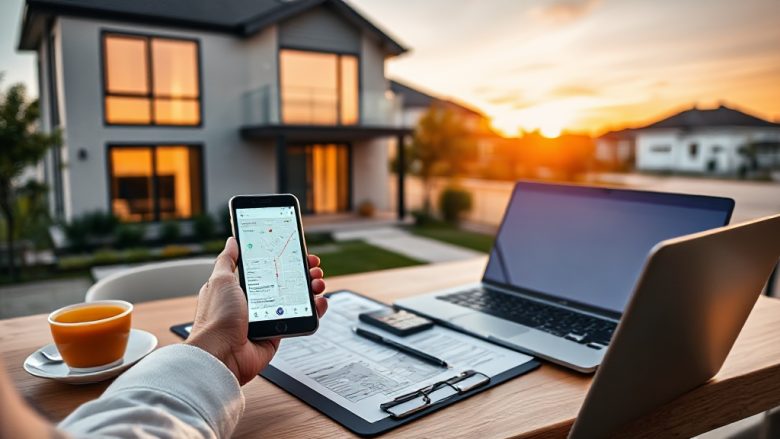
You need a reliable number, but you do not want to spend hundreds on a valuation you may not need. Here is how to get close without the cost. Whether you are planning a remortgage, weighing up a sale, or just trying to work out whether your home is still worth what you think it is, the figure matters. What most people actually want is a home valuation on a tight budget — a realistic estimate they can use for their own planning, not a formal report to hand to a lender. The good news is that you can get surprisingly close to a professional figure for nothing, provided you are willing to do a bit of legwork and stay honest with yourself about the result.
Start with free online tools and sold-price data
The fastest way to anchor your thinking is to look at what comparable homes near you have actually sold for. Sold prices are public record in many countries, and they are far more useful than asking prices. An asking price is a wish; a sold price is a fact. Spend an hour on a property portal or land registry search and pull together five to ten sales from the last twelve to eighteen months. Match them as closely as you can on property type, number of bedrooms, floor area, and street. The closer the match, the more weight that sale should carry.
Automated online estimators are a reasonable second opinion, but treat them with caution. They work from averages and postcode-level data, so they tend to be weakest where your home is unusual — an extended kitchen, a converted loft, a corner plot, or a street where almost nothing sells. If the tool gives you a number, write it down but do not stop there. Run two or three different estimators and look at the spread. If they disagree by more than about ten per cent, that is a signal your property is hard to price automatically and you need the human checks below.
One practical tip: adjust for condition before you compare. A house that sold for a strong price after a full renovation is not a fair comparison to one that needs a new roof and a new bathroom. Note the condition of each comparable sale and mentally discount or add accordingly. This single step prevents the most common mistake people make when valuing their own home, which is anchoring to the best-looking sale on the street.
Ask an estate agent for a free walkthrough
Most estate agents will value your home for free, and they will usually do it in person rather than over the phone. This is the closest you can get to a professional opinion without paying for one. Book two or three agents rather than just one, because each will bring a slightly different view of the local market. Ask them to explain how they arrived at their figure, not just to state it. A good agent will talk you through the comparable sales they used, the adjustments they made, and where they think the market is heading over the next few months.
Be aware of the incentive at play. An agent who wants your instruction has a mild reason to quote optimistically, because a higher number is more flattering and more likely to win the listing. You can counter this by asking a direct question: if we listed at that price, how long would you expect it to take to sell? A realistic answer is often more revealing than the headline figure. If an agent says a property will sell in a fortnight at the top of the range, that is worth treating with some scepticism.
Use the walkthrough as a free inspection too. Agents see hundreds of homes and will notice things you have stopped seeing — a dated boiler, a tired kitchen, a damp patch you have learned to ignore. Their comments on condition are effectively free advice, and they will help you understand why your home might sit above or below the local average. Take notes during each visit, because after the third appointment the details blur together.
Do your own room-by-room assessment
Before anyone sets foot in your home, walk through it yourself with a notepad and be brutally honest. Go room by room and list what a buyer would see: the age of the kitchen, the state of the bathroom, the condition of the windows, the efficiency of the heating, the state of the roof, and whether the décor is neutral or very personal. Then think about the things that add genuine value rather than just appeal — a usable extension, off-street parking, a decent garden, a good school catchment, or a quiet position away from a main road.
Next, measure. Floor area is one of the strongest drivers of value, and a rough measurement of each room will let you compare your home against the sold prices you gathered earlier on a like-for-like basis. You do not need a laser measure; a tape and a bit of patience will do. Write the total internal area down and see how it stacks up against your comparables. If your home is noticeably larger or smaller, adjust your estimate accordingly rather than pretending the difference does not exist.
Finally, check the negatives. Is there anything that would make a buyer hesitate — a busy road, a shared access, a short lease, a flood risk, or an awkward layout? These factors can knock a meaningful amount off a valuation, and it is better to acknowledge them now than to be surprised later. A candid self-assessment will not give you a precise figure, but it will tell you whether you are at the top, middle, or bottom of the local range, which is often all you need.
When it is worth paying for a professional valuation
There are times when a free estimate simply will not do. If you are applying for a mortgage, the lender will usually insist on its own valuation, and that cost is often unavoidable. If you are dealing with probate, a divorce, or a tax matter, a formal written valuation from a qualified surveyor carries weight that an estate agent’s opinion does not. And if your property is unusual — listed, non-standard construction, or in a very thin market — a professional will save you from a costly misjudgement.
A paid valuation typically costs a few hundred pounds, so it is worth asking whether the decision you are about to make justifies the expense. For personal planning, it usually does not. For anything legal or financial, it usually does. If you do pay, ask for a written report with the comparables listed, so you can see the reasoning rather than just a number. That report is also useful if you need to justify your figure to anyone else later.
The sensible approach is to use the free methods first, get a range rather than a single figure, and only pay when the stakes are high enough to warrant it. Most homeowners find that the free route lands within a few per cent of a professional valuation, which is more than good enough for planning a budget, weighing up a move, or deciding whether a renovation is worth the outlay.
Quick checklist before you settle on a number
Before you commit to a figure, run through these four checks. They take minutes and will keep your estimate grounded.
- You have at least five recent sold comparables, matched on type, size, and location.
- You have had at least two agents walk through and explain their reasoning.
- You have adjusted for condition, floor area, and any obvious negatives.
- Your final figure is a range, not a single point, and you know when a paid valuation is genuinely required.
Frequently asked questions
Are free online valuation tools accurate enough to rely on?
They are a useful starting point but rarely accurate on their own. They work best for standard homes in active markets and worst for unusual properties. Use them to set a rough range, then refine it with sold-price data and an agent’s opinion.
How much does a professional valuation usually cost?
Expect a few hundred pounds for a formal written valuation from a qualified surveyor. Estate agent valuations are normally free. Whether the paid option is worth it depends entirely on what you need the figure for.
Can I value my own home without any help?
You can get close, but it is easy to be too generous to your own property. Comparing against real sold prices and having an agent walk through will correct most of the bias. A self-assessment is best used alongside, not instead of, outside input.
How often should I revalue my home?
Once a year is plenty for personal planning, or whenever the local market shifts noticeably. There is little point checking monthly, because short-term movements are mostly noise.