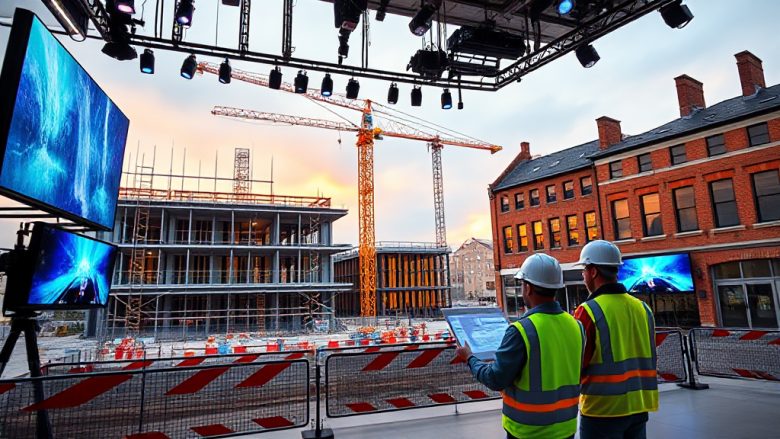
Commercial construction in 2026 is being reshaped by cost pressure, climate rules, and new ways of working. These are the trends worth tracking now.
Anyone planning a build, a fit-out, or a major refurbishment this year knows the ground keeps shifting. Material prices have settled compared with the wild swings of a few years ago, but they haven’t returned to old levels. Energy codes are tightening in most major markets. And the way tenants use commercial space continues to change, which changes what gets built and how. The commercial construction trends to watch in 2026 aren’t abstract talking points. They show up in tender returns, programme dates, and the questions your contractor asks before pricing a job. What follows is a practical read on five of them, with a short note on what each means for your next project.
1. Low-carbon materials move from pilot to procurement
For years, low-carbon concrete, mass timber, and recycled steel were things you trialled on a showcase project or read about in trade press. In 2026, they’re increasingly part of ordinary procurement. The driver isn’t sentiment. It’s regulation and reporting. Several jurisdictions now require embodied carbon disclosure for larger commercial schemes, and lenders and institutional tenants increasingly ask for that data before signing. Once you have to measure it, specifying lower-carbon options becomes a cost question rather than a values question.
The practical effect is that suppliers have scaled up. Blended cements with lower clinker content are now widely available at competitive prices in many regions. Cross-laminated timber panels are being produced closer to demand, which cuts both lead times and transport emissions. Recycled-content structural steel is no longer a special order in some markets. The catch is that low-carbon specifications often need earlier design decisions. If you lock in a conventional mix by default, you may find yourself reworking drawings later to hit a reporting threshold.
What it means for you: Bring carbon targets into the brief at concept stage, not at tender. Ask your design team which two or three material swaps would cut the most embodied carbon for the least cost, and get those priced early. A small change in the structural mix or frame choice is far cheaper to make in month one than month nine.
2. Retrofit-first thinking reshapes the pipeline
The biggest shift in commercial construction this year isn’t a new building method. It’s a change in what gets built at all. Retrofitting an existing office, warehouse, or retail unit is often faster, cheaper, and lower-carbon than demolition and new-build. Planning regimes in several cities now actively favour reuse, and in some cases make demolition harder to justify. Meanwhile, the economics of stranded assets are pushing owners to upgrade rather than replace.
That doesn’t mean retrofit is easy. Existing structures throw up surprises: asbestos, undocumented services, structural assumptions that don’t match reality. But the industry has adapted. Contractors are building specialist retrofit teams. Survey techniques like laser scanning and drone-based facade inspection have become routine, which reduces the guesswork that used to blow retrofit budgets. Deep retrofits that combine envelope upgrades, plant replacement, and internal reconfiguration are now a recognisable project type with its own cost models.
What it means for you: If you own or occupy an older building, commission a proper condition and opportunity survey before assuming you need to move. A retrofit feasibility study is cheap compared with a relocation. And if you do go down the new-build route, be ready to justify why reuse wasn’t viable.
3. Energy performance rules tighten across commercial stock
Minimum energy performance standards for commercial buildings are moving from voluntary to mandatory in more places. The details differ by jurisdiction, but the direction is consistent: buildings that can’t demonstrate a certain level of efficiency will face restrictions on letting, higher compliance costs, or both. For landlords and occupiers, this turns energy performance from a sustainability nice-to-have into a commercial risk.
What’s changed in 2026 is the quality of the data. Smart metering, sub-metering, and building management systems now generate granular performance information that can be checked against design predictions. That’s useful for optimisation, but it also means a gap between predicted and actual performance is harder to hide. Some owners are discovering that buildings certified as efficient on paper don’t perform that way in use, often because of how systems are commissioned and operated rather than how they were designed.
What it means for you: Treat commissioning and post-occupancy monitoring as part of the construction scope, not an afterthought. Budget for a soft landings period where the contractor stays involved while systems are tuned. It costs a little more upfront and saves a lot of awkward conversations later.
4. Industrial and data-driven demand keeps reshaping floorplates
Demand for industrial and logistics space remains strong, but the buildings themselves are changing. Warehouses are getting taller to make better use of land, with more sophisticated racking and automation built in from the start. Power capacity, not floor area, is increasingly the constraint on what a site can support. Meanwhile, data centre and edge computing projects continue to absorb construction capacity in many regions, which affects pricing and labour availability for everyone else.
The knock-on effect for ordinary commercial projects is real. Specialist trades, particularly electrical and mechanical, are stretched. Lead times for switchgear, transformers, and some plant items remain long. Projects that assume standard delivery windows can find themselves waiting months for critical equipment. Designers are responding by specifying earlier, ordering long-lead items before main works start, and building more float into programmes.
What it means for you: Map your long-lead items at the earliest possible stage and get them ordered or at least reserved. If your project depends on a significant power upgrade, start the utility conversation now rather than when the shell is up. Programme risk in 2026 is often about equipment and connections, not construction labour.
5. Digital delivery and offsite methods become the default on larger jobs
Digital tools in construction have been talked about for a decade. In 2026, several of them have quietly become standard practice on larger commercial projects. Common data environments, where drawings, models, and site records live in one place, are now expected by clients rather than offered as an extra. Clash detection during design is routine. Progress tracking via regular site scans is increasingly common on projects above a certain size.
The more visible change is offsite manufacturing. Bathroom pods, plant skids, prefabricated risers, and modular facade elements are being made in factories and assembled on site. That shifts work from a weather-dependent, labour-constrained environment into a controlled one. It can cut programme duration and improve quality consistency. It also changes the design process: offsite elements need to be frozen earlier, because you can’t change a factory-built pod the week before it ships.
What it means for you: If your project is repeatable in any way, ask whether offsite manufacture makes sense. Hotels, student accommodation, healthcare, and standard office fit-outs are common candidates. Be prepared for a different design rhythm, with earlier sign-offs and less tolerance for late changes.
Outlook
The through-line across all five trends is that commercial construction in 2026 rewards earlier decisions. Carbon, energy performance, long-lead equipment, and offsite manufacture all punish late changes more than they used to. The projects that run smoothly this year will be the ones where the brief, the budget, and the key specifications were settled before the first shovel hit the ground. For anyone planning a build or refurbishment, the most useful thing you can do right now is get your design team and contractor talking earlier than feels comfortable.